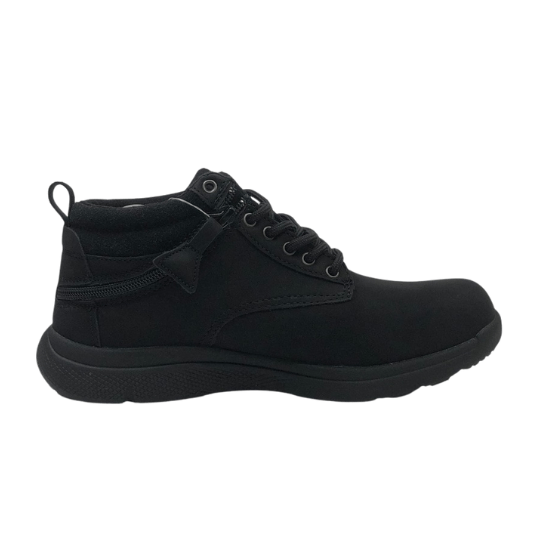
AFO Friendly Boots: How to Choose Adaptive Boots
Boots are one of the hardest things to fit over a leg brace. A tall, stiff shaft has to pass over the brace, the ankle and the heel, and a narrow boot leaves no room for the plastic. Adaptive boots solve this with an opening that goes all the way down, a wide and deep toe box and a removable insole. This guide explains what to look for in AFO friendly boots and adaptive boots for kids, women and men.
This guide is general shopping advice, not medical advice. Your orthotist or physical therapist can tell you how much room your brace needs.
Why ordinary boots do not work with an AFO
- The opening is too small. Most boots open only at the top, so the foot and brace have to bend their way in.
- The shaft is stiff. A firm ankle collar presses on the brace straps and the calf.
- The toe box is shallow. An AFO footplate takes up room under and around the foot, so a normal boot pinches.
- The insole is fixed. Without a removable insole there is no way to make extra depth.
What to look for in AFO friendly boots
1) A zip that opens the boot fully. A long rear or side zip that opens down to the heel lets the foot and brace go in without forcing. Our Scout boots use the same patented rear Easy Shoe Access zip as our sneakers. See our guide to zipper shoes.
2) Width and depth. A wide fit and extra toe box depth leave room for the footplate, a custom orthotic or swelling.
3) A removable insole. Taking it out gives the most room for a brace. Keep it in the boot on the side without a brace.
4) An ankle height that suits the brace. An ankle boot is usually easier than a tall boot. With a taller AFO, check that the top of the boot does not sit on the brace straps.
5) A flexible, slip resistant sole. Boots are often worn in wet or icy weather, when a good grip matters most.
6) Smooth linings. Fewer seams mean fewer pressure points against the brace and skin.
How to size boots over a brace
- Measure the foot with the brace on, standing, late in the day.
- Some people need half a size or more bigger on the brace side. If the difference is large, a split size pair fits both feet.
- Try the boot with the sock you will wear over the brace.
- Check for red marks after the first wear.
Our foot sizing guide explains how to measure, and our guide to shoes that fit over AFOs and SMOs covers brace fitting in more detail.
Adaptive boots from Friendly Shoes
The Scout is our adaptive boot: everyday ankle boot styling with a patented rear zip, a removable dual density memory foam footbed, a flexible slip resistant outsole, smooth sensory friendly linings, and a wide width with extra toe box depth.
- Scout Desert Spice Kids’ Boot: room for growing feet, orthotics, AFOs and SMOs
- Scout Black Women’s Boot
- Scout Desert Spice Men’s Boot
Sizes vary by style, so check the product page for what is available. Shoes can be returned within 30 days if lightly worn indoors (returns policy).
Adaptive boots for kids
Children with braces often go through boots fast. Look for a zip they can learn to use alone, room for the AFO or SMO, and a sole that handles the playground and wet days. Check the fit every few months. More in our guides to shoes for cerebral palsy and adaptive shoes for kids.
Frequently asked questions
Can you wear boots with an AFO?
Yes, if the boot opens wide enough to get the brace in and has room inside for the footplate. Look for a zip that opens down to the heel, a wide and deep fit and a removable insole.
What are the best boots for AFO braces?
Ankle boots with a long rear or side zip, a wide toe box with extra depth, a removable insole and a flexible, slip resistant sole. Avoid stiff, narrow boots that only open at the top.
Do I need a bigger size boot for an AFO?
Sometimes half a size or more on the brace side, but measure with the brace on rather than guessing. Extra width and a removable insole can mean you do not need to size up as much.
What are adaptive boots?
Adaptive boots look like ordinary boots but are easier to put on and fit more feet: a zip or wide opening, room for braces and orthotics, and closures that work for people with limited hand strength.
Are there boots for disabled people?
Yes. Adaptive boots are designed for people with disabilities, braces, swelling or limited mobility, and for anyone who finds ordinary boots hard to put on.